


When it comes to lighting fixtures, one of the most common terms you'll encounter is E26 and E27 bulbs. But what exactly are E26 and E27 bulbs, and how do you choose the right one for your needs? In this guide, we'll delve into the differences between these two types of bulbs and provide tips on how to select the perfect bulb for your lighting fixtures.
The Intro to E26 Bulb and E27 Bulb
Based on this, E27 bulbs are just 1mm longer than E26 bulbs in screw diameter. Many people may assume that E26 and E27 are the same or interchangeable. Indeed, E26 and E27 are mechanically interchangeable but it does not necessarily meet the electrical safety standards that the lamp and lampholders are designed for.
That's because, E26 and E27 standards are designed to totally different voltage levels, which are 120V AC and 240V AC respectively. That said, E26 bulb bases receive voltage up to 120VAC.
So E27 bulbs are safe to use in E26 lampholders, while E26 bulbs will lead to short circuits and electrical fires when installed in E27 lampholders. Actually, E26 & E27 bulbs have other slight differences that are closely related to their applications.
What are E26 and E27 bulbs and sockets?
The first light bulbs and their bases were developed by Thomas Edison. This is why the base of screws in bulbs is called Edison Screws or ES base. These bases are still used in bulbs today.
The E26 is the standard thread size group for bulbs in North America. In Europe it is E27. The number following the letter E is the diameter of the external thread screw in mm. So, for an E26 bulb, the diameter of the base is 26 mm, while the E27 has a base diameter of 27 mm.
The European variant, the E27, is rated at 240 volts. The E26 is rated at 120 volts. It is easy to put an E26 bulb into an E27 socket. The same is true for an E27 bulb in an E26 socket. There will be no problem with this. However, though the bulbs can fit both types of sockets, the voltage rating is different from each other.
Because of the essential incompatibility in the voltage, the incandescent E26 bulb could not be used in an E27 socket with 240 V AC. Similarly for E27 bulbs in E26 sockets.
Quick Comparison Table

What are the specifications of these bulbs?

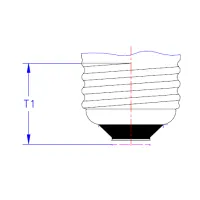 Length of Screw (MIN)
|
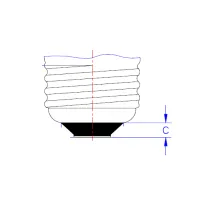 Insulator Cap Height
|
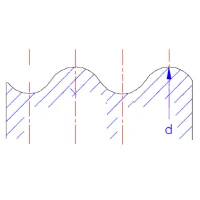 Screw Diameter at Thread Peak
|
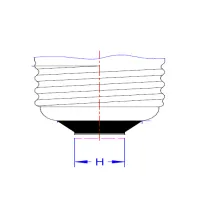 Live Contact Pad Width |
What are the differences in electrical safety between these two bulbs?
The mechanical difference between the two bulbs seem insignificant. However, the difference exists because of each bulb’s designed voltage level. As we have already mentioned earlier, the E26 lamps are made for markets in North American which uses 120 volts AC. The E27’s design is used for other markets. The norm is 240 volts AC.
There are additional precautions taken for E27 bulbs since they are designed to be used with circuits of higher voltage. This is why there is enough allowance between the live and the neutral contacts.
The length of the screws used in E27 lamps are longer. With a longer screw length, there will be more precision in the alignment of the screws in the socket. An improperly aligned screw decreases the space between the neutral screw threads and the live contact. This can increase the risk of a short circuit or an electric arc.
The thread trough diameter of E27 lamps is wider. This can help give a tighter and more secure contact. This can help protect against the entrance of moisture and debris in the socket. Moisture and contamination elevate the risk of short circuit and electrical fires at high voltage levels.
The height of the E27 lamp insulators is taller so that the space between the neutral screw base and the live contact is increased. This difference can help prevent the risk of short circuit.
From the standpoint of electrical safety, E26 and E27 lamps may be similar mechanically and interchangeable. But if you use an E26 lamp in an E27 socket at 240 volts, there is a greater risk of electrical fires and short circuits.
2. The Mechanical Difference: It’s More Than 1mm
The "E" in these bulbs stands for Edison Screw, and the number refers to the diameter in millimeters. While a 1mm difference seems negligible, international safety standards (IEC) create distinct physical designs:
E27 bases are longer: They are designed to ensure a more secure fit in high-voltage sockets.
E27 has a taller insulator: The bottom "live" contact is further separated from the screw threads. This prevents electrical "arcing" (jumping), which is a much higher risk at 240V than at 120V.
3. The Voltage Trap: Why It Matters
Crucial Rule: Mechanically interchangeable does NOT mean electrically compatible.
The biggest risk isn't the fit; it's the Voltage. E26 bulbs are traditionally designed for 120V systems, while E27 bulbs are built for 240V systems.
DANGER: If you plug a 120V-only E26 bulb into a 240V E27 socket, the bulb will likely blow out instantly and could potentially start an electrical fire.
3. Advice for International Users & Importers
If you imported a lamp from Europe (E27) to the USA (120V):
Your lamp has an E27 socket. Since your wall outlet provides 120V, the simplest and safest solution is to buy . They will fit into the E27 socket, and since they are rated for 120V, they will operate perfectly.standard US E26 LED bulbs
If you are moving from the USA to Europe/China (240V):
Do not bring your 120V E26 bulbs. They are not built for a 240V power grid. You must purchase new E27 bulbs rated for 220V-240V upon arrival.


